For businesses operating commercial kitchens, fire is one of the most significant and costly hazards they will encounter. From restaurants and hotels to health clubs and stadia, the consequences of a kitchen fire can be devastating, resulting in serious property damage, prolonged business interruption, and potential harm to staff and customers.
Here is what you need to know to help stay protected.
Why Commercial Kitchens Demand Special Attention
Cooking is consistently identified as a leading cause of fire in commercial premises. Fires that start in a kitchen rarely stay there. Once ignited, they can spread rapidly into other areas of a building, escalating from a contained incident into a major loss event. For your clients, this means not only significant repair costs but potentially months of business interruption at a time when margins are already under pressure.
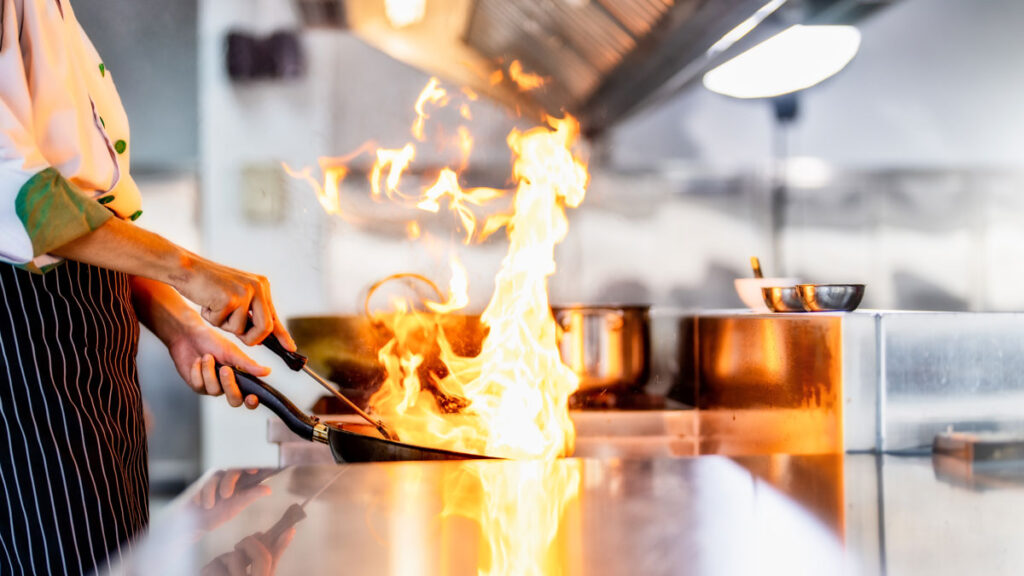
The businesses most exposed include:
- Restaurants, cafes and takeaways
- Public houses and hotels
- Health and fitness clubs
- Healthcare facilities, hospitals and residential homes
- Sports grounds and stadia
The Key Ignition Risks
Understanding where fires start is the first step in preventing them. In commercial kitchens, two areas stand out above all others.
Deep fat frying equipment is a primary source of ignition. There is a surprisingly narrow margin between safe cooking temperatures (around 205°C) and the point at which oils begin to give off flammable vapours (around 230°C), with spontaneous combustion occurring between 310°C and 360°C. Old or contaminated oil narrows this margin further. Placing fat fryers close to other cooking appliances with open flames or exposed heating elements adds additional flash-over risk.
Extraction ductwork is equally critical. Grease and fat deposits accumulate in canopies, filters and ducting over time. Flames, sparks and hot gases from cooking activities can ignite these deposits, and where ducting runs through or near combustible building elements such as timber floors or flat roofs, fire can spread with alarming speed. Fan motor failures can also generate sparks or overheating, turning a maintenance issue into a fire incident.
Other common causes include unattended cooking equipment left on outside working hours, and cleaning cloths contaminated with grease coming into contact with heat sources.
What Good Risk Management Looks Like
When reviewing operations, there are several areas of risk management you should be encouraging them to have in place.
Equipment and Installation
- Cooking appliances should be installed in designated areas with non-combustible walls and ceilings, or with combustible surfaces properly overlaid with incombustible material.
- Deep fat fryers should be fitted with a separate high-temperature limit control (non-self-resetting) that shuts off the heat source if oil temperature exceeds 230°C, in addition to the standard cooking thermostat.
- A minimum clearance of 500mm should be maintained between deep fat fryers and any other appliance that could act as an ignition source. This distance may be reduced where a metal baffle or equivalent screening is provided.
- Emergency shut-down controls for power, fuel supply and extraction systems should be clearly labelled and readily accessible.
Operational Practices
- Cooking equipment should only be operated by trained and authorised staff.
- Equipment should never be left unattended while heat sources are active, and all power and fuel supplies should be isolated at the end of each working day.
- Oil and fat in deep fat fryers should be changed regularly, and care should be taken when replenishing to avoid overfilling or spillage, particularly when equipment is hot.
Extraction Systems
- Mechanical extraction systems reduce the risks for all cooking equipment producing heat, fumes or combustion products.
- Ducting should be constructed from galvanised or stainless steel, with liquid-tight seams and smooth internal surfaces to aid cleaning. Bends that collect residues should be designed out wherever possible.
- Extract canopies, filters and grease removal devices should be cleaned at least weekly.
- Full duct cleaning by a competent contractor, such as a BESA-approved company, should be carried out at intervals determined by usage:
| Daily Frying Time | Recommended Cleaning Frequency |
| 12 to 16 hours | Every 3 months |
| 6 to 12 hours | Every 6 months |
| Under 6 hours | Annually |
Fire Protection
- Staff should be fully trained in the use of catering and fire protection equipment, including the specific hazards of fighting cooking oil and fat fires.
- Fire blankets and Class F portable fire extinguishers should be in place and regularly inspected and maintained by an approved supplier.
- Consideration should be given to installing a fixed suppression system approved to LPS1223 or UL300, designed to protect both cooking equipment and the overhead canopy and ducting. These systems should be linked to an audible or remote signalling device.
Note: Information detailed in Technical Talks has not been verified for accuracy by a third party. None of the information should be taken as legal or professional advice.